Optimizing Eclipse Dataspace Component Deployments on AWS: A Deep Dive into Cost, Performance, and Sustainability

When organizations embark on deploying Eclipse Dataspace Components (EDC) connectors on Amazon Web Services (AWS), a primary and often daunting challenge is accurately predicting and managing the associated infrastructure costs. Without clear financial benchmarks and a comprehensive understanding of underlying resource consumption, making informed decisions regarding workload sizing, environment configurations, and long-term investment becomes exceedingly difficult. This financial uncertainty can impede adoption and scalability, despite the clear strategic advantages that data spaces offer in fostering secure and sovereign data exchange.
The journey to understanding these dynamics has been meticulously documented across a three-part blog series. The initial installment provided a foundational understanding of data space architectures and the intricacies of EDC, aligning with the stringent standards set by the International Data Space Association (IDSA). Building upon this groundwork, the second part delved into robust, production-ready architectural patterns for deploying EDC connectors on AWS, emphasizing critical operational excellence, security, and reliability principles essential for any enterprise-grade deployment. This concluding article of the series serves as a capstone, meticulously examining the remaining three pillars of the AWS Well-Architected Framework: Performance Efficiency, Cost Optimization, and Sustainability. It provides a detailed roadmap for identifying core cost drivers, estimating monthly expenses for varying workload criticalities, and outlining strategic optimization techniques capable of reducing expenditure by up to 58%.
The Evolving Landscape of Data Sharing: A Context for Data Spaces
The concept of data spaces has emerged as a transformative paradigm in an era increasingly defined by the need for secure, controlled, and collaborative data exchange. Traditional data sharing models often struggle with issues of trust, data sovereignty, and interoperability, particularly when multiple independent organizations need to exchange sensitive information while adhering to strict regulatory frameworks like GDPR or industry-specific compliance mandates. Data spaces, underpinned by frameworks like the Eclipse Dataspace Components (EDC), address these challenges head-on. They establish decentralized ecosystems where participants maintain full control over their data, defining granular access policies and ensuring auditability, even when data traverses organizational boundaries.
Eclipse Dataspace Components (EDC) represent a pivotal open-source project facilitating the creation and operation of these sovereign data spaces. Developed under the Eclipse Foundation, EDC provides the foundational building blocks—including connectors for data providers and consumers, policy enforcement mechanisms, and catalog services—necessary to implement IDSA-compliant data spaces. The IDSA, a leading global organization, champions secure data exchange, fostering a trusted environment for data sharing across industries by setting architectural and operational standards. The increasing adoption of EDC across sectors like manufacturing, automotive, and healthcare underscores its growing importance in enabling data-driven innovation and new business models, making cost-efficient deployment on scalable cloud platforms like AWS a critical consideration.
Deconstructing Cost Drivers in Decentralized Data Architectures
Understanding the financial implications of data space deployments begins with identifying the primary cost drivers. Data spaces, by design, are secure and sovereign environments facilitating complex data sharing across independent entities. This inherently involves robust infrastructure to support high availability, stringent security protocols, and efficient data transfer. The primary factors influencing infrastructure costs are directly tied to performance and reliability requirements, alongside the sheer volume and velocity of data moving across the network. High-performance demands, such as real-time data streaming or low-latency API interactions, necessitate more powerful and often more expensive compute and database resources. Similarly, large data volumes and frequent transfers contribute significantly to storage and network egress costs.
Crucially, it is vital to distinguish between two distinct types of infrastructure within a data space: those managed by a central Dataspace Governance Authority (DSGA) and those hosted by individual participants. The DSGA typically provides shared services like central identity management, discovery functions, and overall governance. In contrast, participants—acting as both data providers and consumers—are responsible for deploying and managing their own EDC connectors. This blog post specifically focuses on the costs associated with these participant-level EDC connector deployments on AWS, offering direct insights for organizations joining a data space.
Fictional Usage Assumptions: A Baseline for Cost Estimation
To provide a tangible basis for cost estimation, a set of technical and operational assumptions has been established. These assumptions serve as a practical baseline, allowing organizations to extrapolate and tailor estimates to their specific usage patterns.
Technical Assumptions:
- Data Volume: 5 GB per participant. This figure is designed to encompass approximately six months of historical data, including necessary backups, ensuring data availability and recovery capabilities. For many small to medium-sized data sharing scenarios, this represents a reasonable starting point, covering metadata, contractual information, and a limited volume of actual shared data assets.
- Network Traffic: 20 GB/month per participant. This quantifies the data transfers occurring between various participants within the data space. It accounts for both inbound and outbound data movements, reflecting typical collaboration patterns where data is frequently exchanged for analysis, processing, or integration.
- API Calls: 100,000/month per participant. This metric captures the frequency of interactions with the EDC connector’s various endpoints. It includes essential operations such as catalog queries (discovering available data assets), contract negotiations (establishing terms for data access), and initiating data transfers. Such a volume suggests active participation in a data space, exploring and leveraging diverse data offerings.
- OAuth Token Requests: 1,000/month per participant. These requests are critical for machine-to-machine authentication, ensuring secure communication and authorization for data plane operations. While less frequent than general API calls, their necessity for every secure data interaction makes them a key component of the overall operational profile.
Operational Assumptions:
Beyond technical metrics, operational assumptions significantly influence overall cost and resource allocation. These include:
- Full-time Operations (24/7): The assumption that connectors run continuously, ensuring constant availability for data sharing activities.
- High Availability: Deployment across multiple Availability Zones for resilience, implying redundant resources.
- Automated Backups: Regular data backups for disaster recovery and data integrity.
- Continuous Monitoring: Utilization of AWS monitoring services for performance, security, and anomaly detection.
- Standard Security Practices: Implementation of best practices for network security, access control, and secret management.
- Regional Deployment: All resources deployed within a single AWS region, influencing specific pricing tiers.
- Managed Services Preference: Prioritization of managed AWS services to reduce operational overhead.
Deployment Architecture and Cost Scenarios
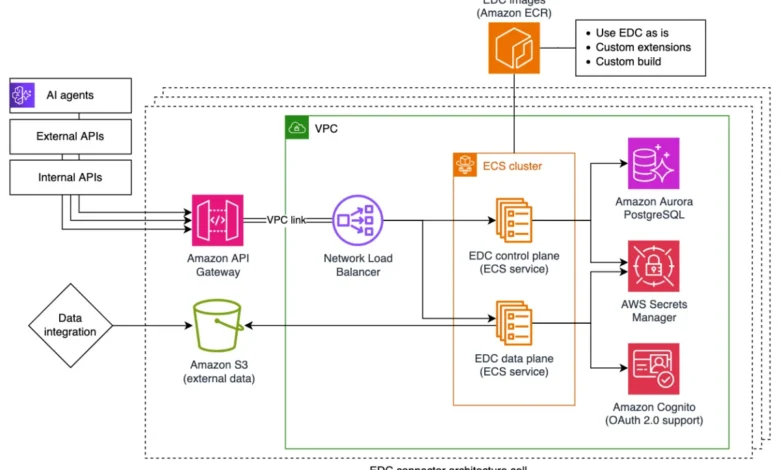
The reference architecture for deploying production-ready EDC connectors on AWS, as detailed in Part 2 of this series, forms the bedrock for these cost analyses. This architecture (typically involving services like Amazon ECS, Amazon Aurora, Network Load Balancer, AWS Secrets Manager, Amazon Cognito, Amazon ECR, Amazon API Gateway, and Amazon S3) is designed for robustness, scalability, and security.
Based on this architecture, two distinct cost scenarios are considered, differentiated primarily by the criticality of the workload they support:
- Business-Critical Workloads: These environments demand high availability, consistent performance, and rapid recovery, typical for live production systems processing sensitive or high-value data. They often require dedicated, high-performance resources and redundant configurations.
- Non-Critical Workloads: This category encompasses development, testing, experimentation, or batch processing environments where occasional interruptions or slightly reduced performance might be acceptable. These scenarios allow for more aggressive cost-saving measures, such as utilizing burstable instances or spot capacity.
Both scenarios adhere to the architectural patterns established in Part 2, with the fundamental differences lying in the sizing of compute and database resources, reflecting varying performance and availability requirements.
Cost Estimation: Business-Critical Workloads
For business-critical EDC connector deployments, the focus is on robust, highly available, and performant infrastructure. The following estimates, based on the aforementioned assumptions, illustrate the relative cost contribution of each AWS service. It is important to note that actual costs may vary due to specific usage patterns, data volumes, and regional pricing. However, these figures effectively highlight the primary cost drivers and, consequently, the areas with the highest potential for optimization.
| AWS Service | Configuration | Monthly Cost (USD) |
|---|---|---|
| Amazon Aurora PostgreSQL-Compatible Edition | db.r6g.large (2 vCPU, 16 GB), 20 GB storage + 10 GB backup | 276.00 |
| Amazon Elastic Container Service (Amazon ECS) with AWS Fargate | 2 vCPU, 4 GB RAM, always on | 83.00 |
| Network Load Balancer | 20 GB processed data | 20.00 |
| AWS Secrets Manager | 10 secrets | 4.00 |
| Amazon Cognito | 1K machine-to-machine (M2M) token requests | 2.25 |
| Amazon Elastic Container Registry (Amazon ECR) | 2 GB storage, 10 GB transfer | 1.00 |
| Amazon API Gateway | 100K REST API calls | 0.40 |
| Amazon Simple Storage Service (Amazon S3) | 5 GB Standard tier | 0.10 |
| Total | 387.00 |
In this business-critical scenario, Amazon Aurora PostgreSQL emerges as the most significant cost driver, accounting for approximately 71% of the total monthly expenditure. The db.r6g.large instance type is chosen for its high memory capacity and consistent performance, crucial for database-intensive workloads requiring low latency and high reliability, typical for persistent storage of EDC contract agreements, policy metadata, and transaction logs. Amazon ECS with AWS Fargate contributes the second-largest portion, as it necessitates continuously running containers to ensure the environment’s constant availability and responsiveness. The Network Load Balancer, handling 20 GB of processed data, represents the third notable cost component, ensuring efficient and secure traffic distribution to the connector endpoints. The remaining services, while essential for security, container image management, API exposure, and basic storage, contribute only a small fraction to the overall cost, demonstrating their efficiency at these usage volumes. This distribution underscores that the core infrastructure—database and compute—forms the majority of the baseline cost for business-critical operations.
Cost Estimation: Non-Critical Workloads and Significant Savings
For organizations running development, testing, or experimental EDC environments, substantial cost reductions of up to 58% are achievable by implementing rightsizing strategies and leveraging more flexible AWS services like Amazon EC2 Spot capacity. These non-critical workloads can tolerate occasional interruptions or periods of lower performance, making them ideal candidates for such optimizations.
| AWS Service | Configuration | Monthly Cost (USD) |
|---|---|---|
| Amazon Aurora PostgreSQL-Compatible Edition | db.t4g.medium (2 vCPU, 4 GB), 20 GB storage + 10 GB backup | 110.00 |
| Amazon ECS with AWS Fargate Spot | 2 vCPU, 4 GB RAM, always on | 26.00 |
| Network Load Balancer | 20 GB processed data | 20.00 |
| AWS Secrets Manager | 10 secrets | 4.00 |
| Amazon Cognito | 1K M2M token requests | 2.25 |
| Amazon ECR | 2 GB storage, 10 GB transfer | 1.00 |
| Amazon API Gateway | 100K REST API calls | 0.40 |
| Amazon S3 | 5 GB Standard tier | 0.10 |
| Total | 164.00 |
These figures clearly demonstrate that a non-critical configuration can drastically cut costs while maintaining identical assumptions for data throughput, API capacity, and storage. Amazon Aurora PostgreSQL remains the primary cost driver, but by downgrading to a smaller, more cost-effective instance type (db.t4g.medium), the database cost is reduced by over 60%. This instance type, while offering fewer resources, is perfectly adequate for environments that do not require the constant, peak performance of business-critical systems. From a compute perspective, leveraging Amazon ECS with AWS Fargate Spot capacity delivers remarkable savings, cutting costs by almost 70% compared to the always-on Fargate setup in the business-critical scenario. Fargate Spot instances are spare AWS Fargate capacity offered at a significant discount, with the understanding that they can be interrupted with two minutes of notice. For development and testing, where workloads can be designed to be fault-tolerant or restartable, this is an incredibly efficient option. In total, this optimized configuration reduces the monthly cost by approximately 58%, showcasing the power of rightsizing and leveraging flexible pricing models for suitable workloads.
Key Takeaways on Cost Optimization and Scalability
The comparison between business-critical and non-critical scenarios yields crucial insights into the cost dynamics of EDC connector deployments on AWS. The analysis consistently highlights that the primary cost contributors are database, compute, and load balancing resources. These represent the fundamental baseline infrastructure required to run the EDC connector and support its core functions, rather than charges directly tied to fluctuating usage patterns. Services like Amazon S3, API Gateway, and data transfer charges, while essential, contribute only marginally to the overall costs at the specified volumes.
This cost structure reveals a significant advantage: the architecture scales efficiently with increased usage. As organizations onboard more use cases, increase data volume, and accelerate data velocity through their EDC connectors, they gain disproportionately more value from their existing infrastructure investment without experiencing a proportional surge in costs. The baseline infrastructure can handle a considerable increase in transactions and data without requiring a complete overhaul or massive scaling of the most expensive components. This inherent efficiency makes EDC on AWS a compelling proposition for organizations planning to grow their participation in data spaces.
The AWS Well-Architected Framework: A Holistic Approach for EDC Deployments
Part 2 of this series meticulously applied the Operational Excellence, Security, and Reliability pillars of the AWS Well-Architected Framework to EDC deployments. This final section extends that comprehensive approach, addressing the remaining three pillars: Performance Efficiency, Cost Optimization, and Sustainability. Adhering to these principles ensures not only a financially sound deployment but also one that is robust, agile, and environmentally responsible.
Performance Efficiency:
Optimizing performance efficiency ensures that the system can adapt to changes in demand while maintaining responsiveness and resource utilization.
- Right-size compute resources: It is paramount to match Amazon ECS task definitions precisely to actual workload requirements. Over-provisioning compute resources from the outset is a common pitfall that leads to unnecessary expenses. A pragmatic approach involves starting with smaller configurations and iteratively scaling up based on observed metrics. Tools like Amazon CloudWatch Container Insights provide granular visibility into container performance, CPU utilization, memory consumption, and network activity, enabling data-driven sizing decisions.
- Utilize the flexibility of Amazon Aurora: For workloads characterized by variable demand patterns, Amazon Aurora Serverless v2 offers a compelling solution. This serverless option automatically scales database capacity based on real-time application needs, eliminating the necessity to provision for peak capacity and pay for unused resources. It maintains performance during high-demand periods while optimizing costs during lulls, making it ideal for unpredictable data space interactions.
- Optimize data transfer patterns: Efficient data plane operations are critical to minimize unnecessary data movement, which can impact both performance and cost. Employing Amazon S3 Transfer Acceleration can significantly speed up large data transfers across geographic distances by routing data through AWS edge locations. Furthermore, implementing data compression where appropriate can reduce both transfer times and the amount of data processed, directly impacting network costs and improving overall efficiency. Strategically locating data close to its consumers also reduces cross-region data transfer expenses.
Cost Optimization:
Beyond the basic cost estimations, proactive strategies are essential to continuously optimize expenditure without sacrificing performance or reliability.
- Reduce compute costs for fault-tolerant workloads: For non-critical environments, batch processing, development, and testing workloads that can tolerate interruptions, AWS Fargate Spot offers substantial savings—up to 70% compared to On-Demand pricing. Implementing graceful shutdown handling within containerized applications is crucial to manage Spot interruptions effectively, ensuring that tasks can complete or checkpoint their progress before termination.
- Lower storage costs over time: Data stored in Amazon S3 often has varying access patterns throughout its lifecycle. Configuring Amazon S3 Lifecycle policies allows for the automatic transition of infrequently accessed data to lower-cost storage classes. For instance, historical transfer logs, archived data assets, or older versions of data contracts can be moved from S3 Standard to S3 Intelligent-Tiering (which automatically moves data to the most cost-effective tier based on access patterns) or S3 Glacier Instant Retrieval for long-term archiving with immediate access.
- Monitor for unexpected cost increases: Vigilant financial monitoring is key. Leveraging AWS Cost Explorer provides detailed insights into spending patterns, while setting up AWS Budgets with alerts helps detect and react to unexpected cost spikes. Consistent tagging of EDC-related AWS resources (e.g., by project, environment, or owner) is paramount for accurate cost allocation, chargeback, and identifying specific optimization opportunities.
- Lock in lower rates for predictable workloads: For business-critical connectors with stable, predictable usage patterns, AWS Savings Plans offer significant discounts compared to On-Demand pricing. Savings Plans apply to compute usage across Amazon EC2, AWS Fargate, and AWS Lambda, and specific Savings Plans are available for Amazon Aurora, allowing organizations to commit to a consistent amount of compute usage (measured in USD/hour) for a 1-year or 3-year term in exchange for lower rates.
Sustainability:
The sustainability pillar encourages maximizing resource utilization and minimizing environmental impact. Cloud computing, inherently more efficient than on-premises data centers, offers further optimization opportunities.
- Optimize resource utilization: Higher utilization of provisioned resources directly translates to less waste and a lower environmental footprint. Implementing automatic scaling policies for Amazon ECS tasks to match capacity precisely with demand avoids running idle resources. Furthermore, shutting down non-production environments outside of business hours or during weekends, when possible, significantly reduces energy consumption.
- Select efficient instance types: AWS Graviton-based instances, such as the
r6gandt4gfamilies used in the cost examples, are designed to deliver superior price-performance and energy efficiency compared to equivalent x86 instances. Graviton processors consume less energy while performing the same amount of work, contributing to a reduced carbon footprint for cloud operations. - Minimize data movement: Every data transfer across a network consumes energy. Designing data space integrations to avoid redundant transfers is crucial. This includes caching frequently accessed catalog data from peers locally using the Federated Catalog pattern, and batching operations where feasible to reduce the total number of network round trips and associated energy consumption. Leveraging AWS services that keep data processing close to data storage also minimizes transfer distances.
Broader Implications and Strategic Value
The insights gleaned from this analysis extend far beyond mere cost savings. By meticulously rightsizing AWS infrastructure to align with actual compute and database capacity needs, data space participants can achieve significant economic benefits without compromising the fundamental principles of data security and sovereignty that make data spaces so valuable. The detailed comparison between business-critical and non-critical workload configurations vividly illustrates how a strategic combination of AWS services—such as Amazon Aurora, AWS Fargate Spot, and Amazon S3—can be harmonized to strike an optimal balance between data sovereignty, robust performance, and cost efficiency.
As data spaces continue their rapid adoption across diverse industries and geographic regions, understanding these intricate cost dynamics becomes increasingly vital for organizations planning their network participation. The architectural patterns, deployment scenarios, and cost estimates presented in this series provide a solid foundation for crafting a resilient and economically viable cross-organizational data strategy and embarking on a successful data spaces journey on AWS. This proactive approach ensures that the transformative potential of data spaces—enabling new collaborative business models, fostering innovation, and ensuring regulatory compliance—can be realized sustainably and efficiently.
To initiate this journey, organizations are encouraged to first thoroughly assess the criticality of their EDC workloads to determine whether a business-critical or non-critical configuration is most appropriate. Subsequently, the AWS Pricing Calculator can be utilized to generate tailored cost estimates based on specific data volumes, chosen AWS regions, and anticipated usage patterns. For a practical, end-to-end reference implementation, the "Dataspace Connector on AWS" project on GitHub offers a valuable resource, combining Infrastructure-as-Code principles with custom EDC extensions and integration with AI tooling, providing a concrete starting point for deployment.
References:
- Eclipse Dataspace Components (EDC) project: https://projects.eclipse.org/projects/technology.edc
- AWS Architecture Blog – Part 1: Eclipse Dataspace Components on AWS: Data Sharing Fundamentals: https://aws.amazon.com/blogs/architecture/eclipse-dataspace-components-on-aws-data-sharing-fundamentals/
- AWS Architecture Blog – Part 2: Eclipse Dataspace Components on AWS: Architecture Patterns in Production: https://aws.amazon.com/blogs/architecture/eclipse-dataspace-components-on-aws-architecture-patterns-in-production/
- AWS Well-Architected Framework: https://aws.amazon.com/architecture/well-architected/
- AWS Pricing Calculator: https://calculator.aws/
- Dataspace Connector on AWS GitHub Project: https://github.com/awslabs/dataspace-connector-on-aws
About the authors
[As per original article, no changes or additions needed here.]
Related posts: